

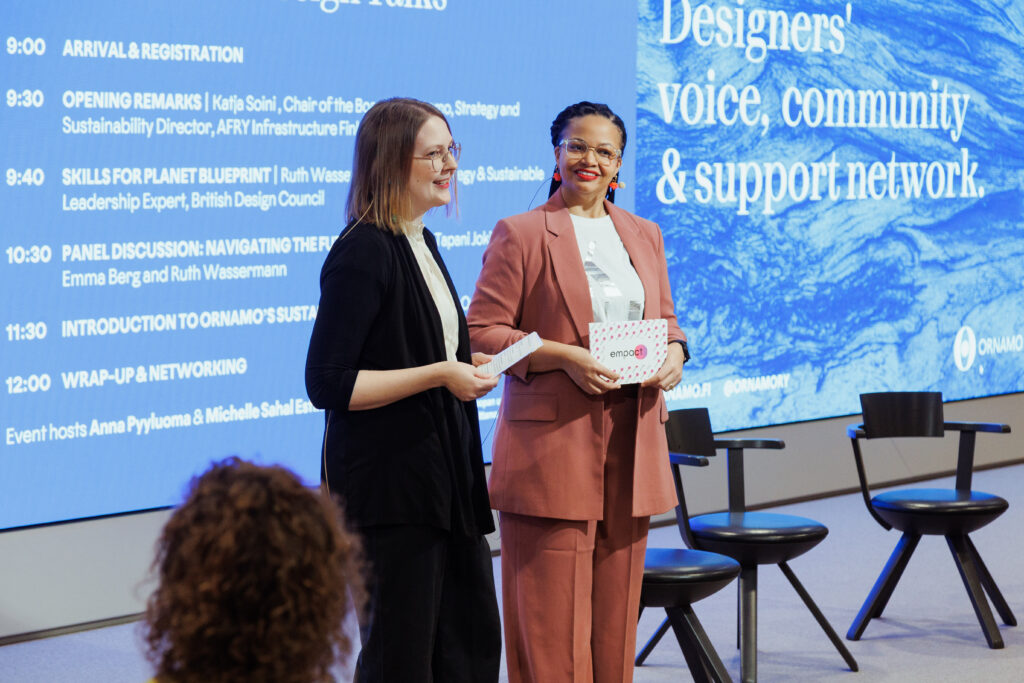
Reflections from Ornamo’s Sustainable Design Talks, by the event hosts Michelle Sahal Estimé and Anna Pyyluoma, co-founders of Empact.
Last week, designers, architects and sustainability professionals gathered at Helsinki City Hall for Sustainable Design Talks, organised by Ornamo Art and Design Finland as part of Architecture and Design Week. The discussions were thoughtful and grounded in a strong sense of shared responsibility and hope.
One thing became clear early on during the morning. Sustainability does not sit outside everyday design work, but should be embedded in the systems we create, the materials we rely on, and the decisions that are repeated on a daily basis.
Sustainability is systemic
Finland is often described as a sustainability frontrunner, yet the figures tell a more complex story. Consumption levels, waste production and recycling rates remain far from where they need to be. In the Helsinki region, much of the waste comes from construction rather than consumer behaviour alone. We often find that sustainability challenges are rarely individual. They are structural and systemic, shaped by how things are designed and governed. As Ornamo’s Chair Katja Soini highlighted, sustainability means everything and nothing if we don’t make it concrete. Making sustainability meaningful requires moving beyond good intentions toward decisions that change how materials flow, how services are organised and how responsibility is shared.
Design is future making
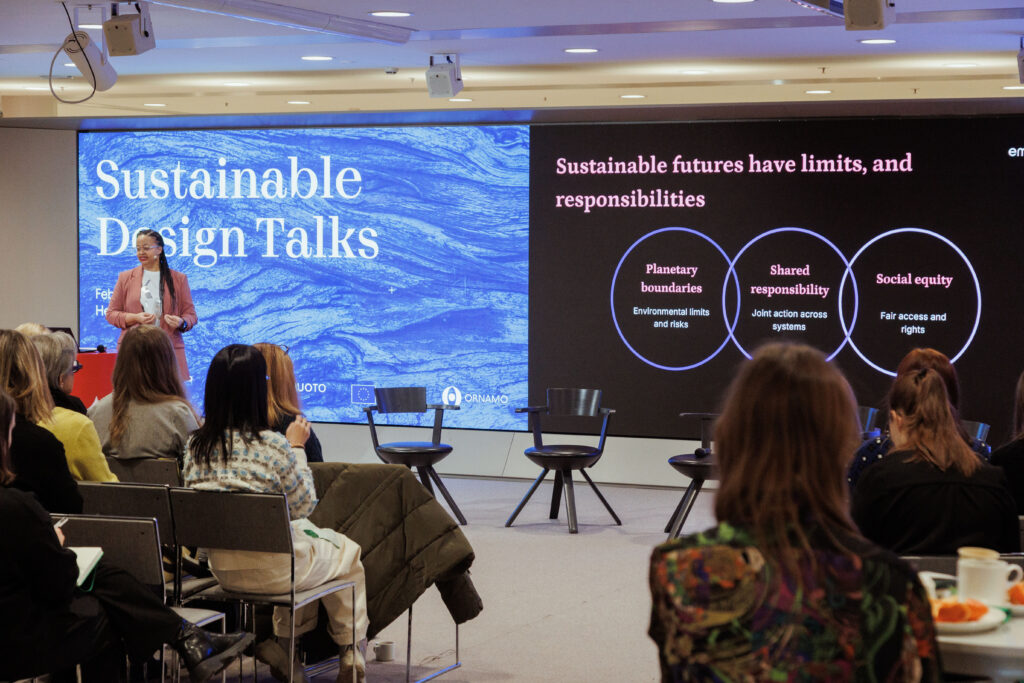
At Empact, we approached the panel discussion through a futures perspective. Design is inherently forward looking and every design decision contributes to shaping the futures people will live in, whether that impact is intended or not. The question is not whether design shapes the future, but how consciously and responsibly that influence is exercised.
Building the future must happen within the limits of our shared environment. At the same time, it must acknowledge social realities. Who benefits from change, who carries its cost, and who is included or excluded all shape whether solutions last. Social and ecological sustainability cannot be separated without weakening both. Service designer Emma Berg captured this human dimension well when she noted that design has the ability to create movements, communities and shared values, and that trust is built through these connections. Trust is the cornerstone of shared responsibilities.
Making sustainability understandable
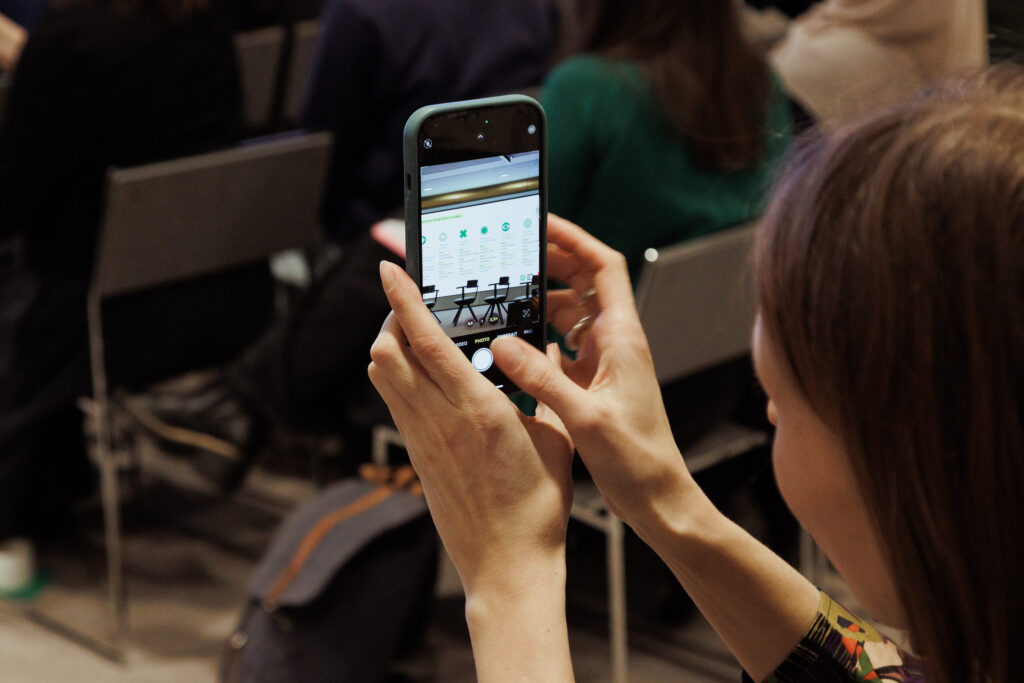
Throughout the panel, speakers returned to the difficulty of working with the term sustainability itself. For some, it refers to materials and supply chains. For others, to tools, behaviours, services or long term impact. We seem to not have a shared understanding about the term and therefore several panelists emphasised the importance of using more concrete language and shared frames of reference.
“If no one understands what you’re talking about, or wants to listen, you won’t convince stakeholders to change direction,” Katja reminded the audience. Speaking about lifecycles, systems and usage over time helps turn sustainability into something people can understand and act on.
Changing the role of design
The discussion also highlighted how the role of design itself is shifting. Instead of constantly producing something new, designers are increasingly asked to focus on longevity. Keeping value in circulation, extending lifecycles and designing services around what already exists are becoming central concerns. And also new opportunities.
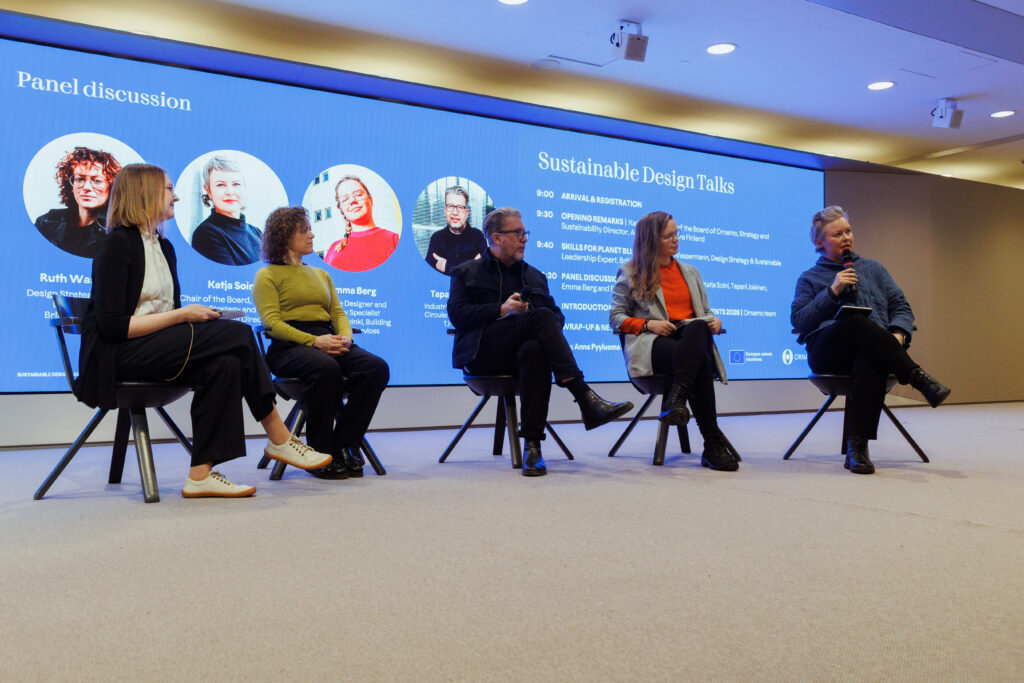
Circular design expert Tapani Jokinen described this as shifting attention away from footprint and toward handprint. Adding value often comes with environmental cost, whereas extending the life of what already exists can have a very different impact.
The future brings increasingly stricter operational environments for designers to function in. Tapani shared an example from IKEA, where designers were challenged to create a dining table that could be sold for 40€. The task initially seemed unrealistic, but it became a catalyst for creativity rather than a limitation. Ambitious constraints, when taken seriously, can change what feels possible. When thinking about sustainability, we could leverage the stricter regulation and turn it into a source of new innovation and creativity.
Grounds for hope
The panelists discussed hope, not as blind optimism, but as forward looking and actionable. Ruth Wassermann from the British Design Council pointed to progress supported by data, regulation and practical tools such as the Skills for Planet Blueprint.
She noted that legislation curbing greenwashing matters, and that creativity remains one of the most powerful tools for influencing behaviour. Several speakers also pointed to younger generations as a sign that values based decision making is becoming more visible in everyday choices.
Building momentum together
For us, the most important insight from the day was that sustainability in action means making small, repeated decisions that accumulate over time and are shared across teams, organisations and communities. Sharing success stories builds hope and ensures the direction is right.
As Katja put it, pick your battles. We can’t solve all of humanity’s wicked problems by ourselves, even if we wanted to. We need to choose one fight to dedicate ourselves to, and make our peace with our choice. Do your thing, others do theirs. And together the impact will be bigger than the sum of our individual actions.
Our call to action is simple. Don’t be the lonely champion, invite others in your battle, listen with empathy and you will move mountains. Join the Ornamo sustainability workshops to continue learning together and to find your companions in this journey.
Vastaa